



Maths
‘’One of the pleasures of looking at the world through mathematical eyes is that you see certain patterns that would otherwise be hidden’’ - Steven Strogatz
Maths at Bitterne Church of England Primary
At Bitterne Church of England Primary School, we believe every child can become a successful mathematician. We teach maths through a mastery approach, helping children develop a deep understanding before moving on to new learning.
Children learn through practical resources, pictures and mathematical symbols, building confidence step by step. We encourage them to explain their thinking, make connections and solve problems, developing the skills they need both in school and in everyday life.
Through curiosity, resilience and regular practice, we aim for every child to enjoy maths and leave us as confident, capable problem solvers.
Maths in action at Bitterne Church of England Primary
Building understanding with practical resources
Children use practical equipment to explore mathematical concepts before moving on to drawings and written methods.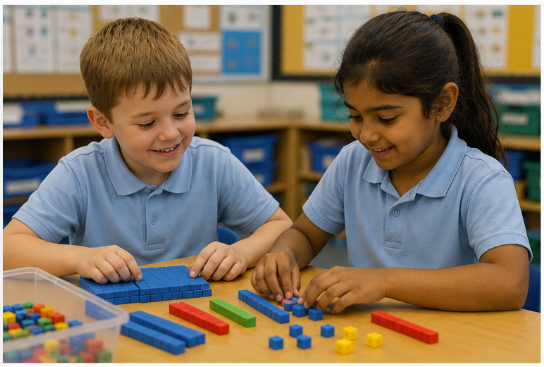
Explaining our thinking
Talking about maths helps children deepen their understanding, justify their ideas and learn from one another.
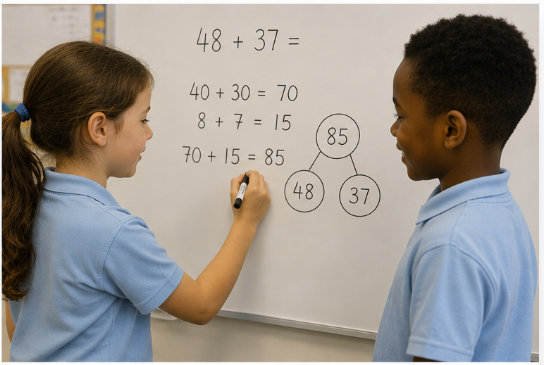
Working together to solve problems
Children work collaboratively to represent their ideas, discuss strategies and solve mathematical problems.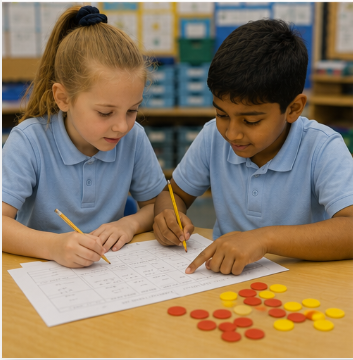
Maths beyond the classroom
Learning takes place in a range of environments, helping children apply their mathematical knowledge to real-life situations.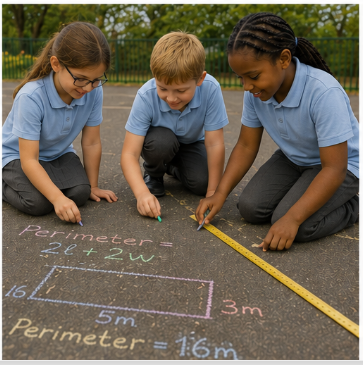
Learning through investigation
Hands-on activities encourage children to explore, reason and make connections between different mathematical ideas.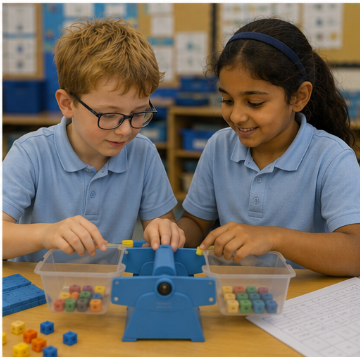
Our Maths Curriculum
Our maths curriculum is carefully planned so that learning builds step by step from Reception to Year 6. Children revisit important concepts throughout the year, helping them strengthen their understanding, improve fluency and make connections between different areas of mathematics.
Children develop confidence through the Concrete, Pictorial and Abstract (CPA) approach. They use practical equipment, pictures and mathematical symbols to build secure understanding before applying their learning to increasingly complex problems.
We place a strong emphasis on mathematical vocabulary, reasoning and explaining thinking so that children can communicate their ideas clearly and confidently.
Times Tables and Number Facts
Quick recall of number facts helps children become confident mathematicians. We teach these in small, carefully planned steps from Reception to Year 6, revisiting learning regularly so that facts become secure.
Children build confidence with number bonds, doubles, halves and multiplication facts before applying these to fractions, decimals and percentages.
Children in Year 4 also take part in the statutory Multiplication Tables Check, helping prepare them for the increasing mathematical demands of Key Stage 2.
Supporting Maths at Home
Just a few minutes of regular practice can make a big difference. Practising number bonds, times tables, telling the time, using money and talking about maths in everyday life all help children develop confidence.
You can also support your child using:
- NumBots – develops number bonds and early calculation skills.
- Times Tables Rock Stars – builds multiplication and division fluency through fun daily practice.
Your child's class teacher will provide login details. Alternatively, please contact the school office if you need another copy.
NumBots |
Times Tables Rock Stars |
We Believe Every Child Can Succeed
We want every child to leave Bitterne Church of England Primary School with the confidence, knowledge and resilience to tackle new mathematical challenges. By developing understanding, fluency, reasoning and problem-solving skills, we prepare children for the next stage of their education and for life beyond school.
Maths Curriculum Documents
The documents below provide further information about the mathematics curriculum taught at Bitterne Church of England Primary School. Parents and carers can explore the curriculum pathway, year group planning, calculation methods and mathematical vocabulary progression to see how learning develops from Reception through to Year 6.
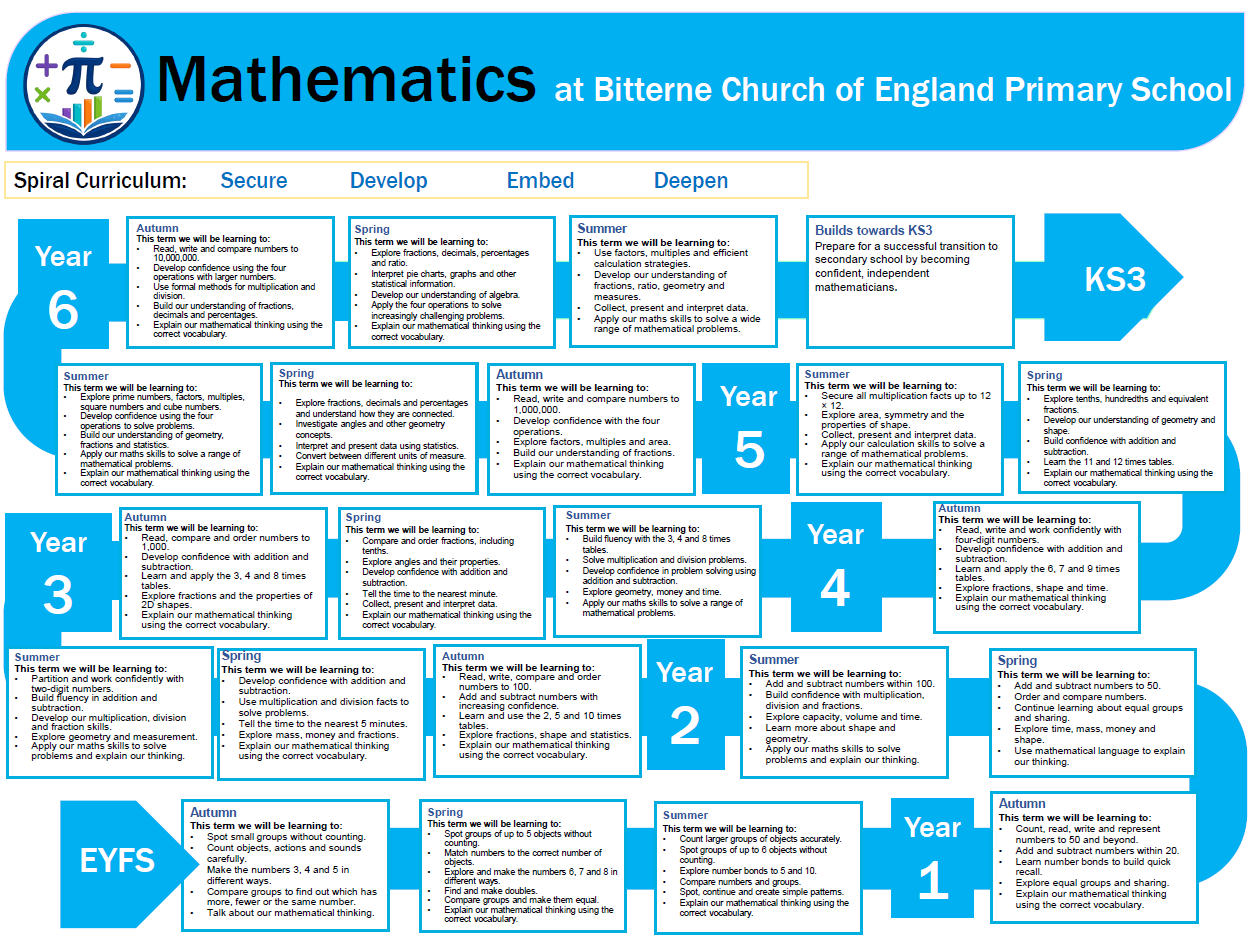
Curriculum Overview
Year R (EYFS)
Year 1
Year 2
Year 3
Year 4
Year 5
Year 6
Vocabulary Progression Year R to Year 6